|
Tour Day 1 - Istanbul
Arrival at Istanbul airport , you will be met and transferred to your
hotel. Overnight.
Tour Day 2 -
Istanbul
Following the breakfast we drive to the 'Old City', we will stop by the
Hippodrome before proceeding to the Blue Mosque, so called because of
the impressive blue tiles lining its walls. Next on our itinerary is
the Museum of Turkish and Islamic Arts. Then we will go into the St.
Sophia Museum. Following this stop, we will go onto the Underground
Cistern built by Justinian in 535, and on to the Suleymaniye Mosque
built by the Master Architect Sinan during the reign of Suleyman the
Magnificent, the Lawgiver.
In
the evening an optional dinner including Belly Dancing with Folklore
Show is available upon request.
Tour Day 3 - Adana
We will take the early flight to Adana, ancient Cilicia , and drive
straight to Tarsus, the birth place of St. Paul. During St. Paul's time
Tarsus was a university city surpassing Athens and Alexandria. Cicero
was a governor here in 51-50 BC. and the romantic meeting between
Cleopatra and Mark Anthony took place in Tarsus. Highlights here will
be St. Paul's well, tomb of Sardanapulus and Cleopatra's Gate. Back to
Adana for dinner and overnight.
Tour Day 4 - Adana
Today we journey East to Antioch-on-the- Orontes, Daphne and Seleucia
Pieria. Antioch is thought to have been founded in 300 BC. Among all
the cities in the world of the first century AD. Antioch offered the
most ferric ground for new ideas, philosophies and religions. First to
preach here was St. Peter followed by St. Paul and Barnabas whose
extensive efforts proved to be very fruitful for Christianity.
Incidentally, the word Christians was first coined in Antioch. The
strong and wealthy community of Antioch contributed financially to the
Christian community of Jerusalem. Highlights include the museum which
houses a superb collection of mosaics from Antioch, Daphne and Seleucia
Pieria, St. Peter's Grotto, the cave church came to be known as the
meeting place of the early Christians. According to the legend, ancient
Daphne was the sacred grove where Apollo tried to rape a nymph of the
same name whom Eros struck with an arrow thus making her incapable of
loving neither a god nor a mortal. Apart from being dedicated to
Apollo, Daphne was also a place of carnal pleasures and any soldier
caught in the area was dismissed from service. The next site we will
visit today is Seleucia Pieria which was the port city of Antioch in
ancient days. The most interesting monument here is the Tunnel of Titus
which is a tremendous canal dug for the purpose of diverting waters of
Orontes river. Another highlight here will be the rock tombs with their
impressive facades pertaining to the Hellenistic period. Return to
Adana for dinner and overnight.
Tour Day 5 -
Cappadocia
After an early breakfast we drive north to Cappadocia and first stop at
Derinkuyu. This is an underground city , carved into soft rocks
resembling a huge labyrinth of tunnels, rooms, kitchens, wine cellars
and passageways. A huge chimney ventilates this 8-leveled dwelling
which was used by Christians hiding from their Roman and Byzantine
persecutors. Their colorful frescoes remain as vibrant as when they
were first made. Fascinating place... Derinkuyu. Further on we come to
Cappadocia whose effect on the visitor is like that of a village out of
Grimm's Fairy Tales. What Turks commonly call "Fairy Chimneys" are
jutting pieces of volcanic rocks that have been beaten and shaped by
the wind and rain. Highlights will be The Apple Church, The Church of
St. John the Baptist and the Church with a Buckle in Goreme. Dinner at
hotel and overnight.
Tour Day 6 - Konya
Right after breakfast, we begin our drive to Konya or ancient Uconium
which became an important Christian city following St. Paul's
preaching. A Phyrigia legend says that Konya was the first city to be
founded after the flood. St. Paul and Barnabas came here in 47 A.D. and
their preaching was accompanied by many miracles. St. Paul made two
more stops here on his second and third journeys. Today's Konya is
quite new but the center of the city is very old. Dinner and overnight.
Tour Day 7 - Antalya
Early morning we will drive to Psidian Antioch (Yalvac) where St. Paul
opened Christianity to the world. Yalvac's history goes back to 280
B.C. During St. Paul's time the population was a mixture of Jews,
Romans and Greeks. Very little is left of Psidian Antioch today. There
is the propylaea of the acropolis with a number of carved stones and
the remains of a Byzantine church. We pass by Egirdir Lake and arrive
in Antalya for dinner and overnight.
Tour Day 8 -
Antalya (Perge-
Aspendos- Side)
Ruins of Perge are 18 kms to the northeast of Antalya. This is where
St. Paul began preaching after arriving from Cyprus. Highlights are,
the Gymnasium, the Bath, the Agora, the Theater, the Stadium and the
Hellenistic Gate. Another one of the Pamphilian cities is Aspendus. The
Theater is the best preserved in the world with its incredible
acoustics. Today's Side is built exactly on top of the ancient city.
Side means "pomegranate" and this fruit has been depicted in the
coinage found in the area. The highlights here will be the Temples of
Athena and Apollo, the State Agora, the Theater and the Museum. Dinner
and overnight in Antalya.
Tour Day 9 -
Pamukkale (Laodicea-
Hierapolis)
We
leave our hotel early in the morning and drive to Hierapolis but before
we get here we stop at Laodicea. We find here two Theaters, a large
Stadium, a Water Tower and an Odeon. The city is supposed to have been
named by Antiochus II in honor of his wife, Laodicea. St. Paul wrote a
letter to the church here(Acts:4:16). We arrive in Hierapolis which was
founded by Pergamon king Telephos and named after his wife Hiera. Most
likely, the very large Jewish element in this city was an important
factor in the rapid expansion of Christianity. During the Byzantine
period the city became the seat of diocese with a large Christian
Church dedicated to St. Philip, martyred here in 80 A.D. Highlights
include the Roman Baths, the Temple of Apollo and the Theater. Dinner
and overnight at Pamukkale.
Tour Day 10 -
Kusadasi
We start early as we will see four sights today. Nearby Hierapolis is
the beautiful ancient site of Aphrodisias . This ancient city of
learning, fine arts and sculpture has provided us with exquisite pieces
of work which are on display on the site. Its Stadium is among the
best-preserved in the world. The "Bishops Palace", Odeon and the
Theater will be the highlights here. Our next stop Didyma served as a
religious sanctuary to god Apollo. Oracular inscriptions in Didyma
indicate dates as far back as 6th century B.C. Legend tells us that
with the arrival of Alexander the Great, the sacred spring of the
Temple which had dried up began to flow again. Highlights will be the
Temple of Apollo. Further north we arrive at Miletus whose history
dates back to 800 B.C. Famous Philosopher Thales comes from Miletus and
he is credited with the theory that all things come from water.
Highlights here are the Theater, Baths of Faustina and the Council
Chamber. Next on our itinerary is Priene with its well planned streets
and graceful buildings and temples. Highlights will be the Agora, the
Ecclesiasterium and the Temple of Athena Polias. Dinner and overnight
at Kusadasi.
Tour Day 11 - Izmir
(Ephesus)
On our way to Izmir this morning we will stop by the famous city of
Ephesus. Our tour will begin with the Basilica of St. John "the
Evangelist" who came here with the Virgin Mary and wrote his Gospel in
Ephesus. The Temple of Artemis, considered as on the Seven Wonders of
the World, was located here. Ephesus as you will see, is in very good
state of preservation and the overall existing view of this ancient
city will make it evident that she was a wealthy cultural and
commercial center in the past. St. Paul's preaching in the area
resulted with the uproar of the Guild of Silversmiths and eventually
the whole population of Ephesus. Highlights include the Library of
Celcius, the Temple of Hadrian, the Fountain of Trojan, the Brothel and
the Theater. We will also stop by the House of Virgin Mary nearby,
where she is reputed to have spent her last years and died. You will be
able to collect some holly water from the Sacred Spring. Dinner and
overnight in Izmir.
Tour Day 12 - Izmir
(Sardis)
We drive to Sardis whose history dates back to 12th cent. B.C. Sardis
felt the influence of Christianity very early and was included in the
Seven Churches of the Apocalypse. During the Byzantine times it was the
seat of a bishopric. Highlights will be a Synagogue, Gymnasium,
Byzantine Church and the Temple of Artemis. We will then proceed to
Thyateria or Akhisar, which was another one of the towns where
Christianity spread quickly. It was the site for one of the Churches of
Revelation. We will see another one in Izmir, when we drive back for
dinner and overnight.
Tour Day 13 -
Ayvalik
On our way to Ayvalik this morning we will stop by hauntingly beautiful
Pergamon which rises high on a hill as one nears the city of Bergama.
Being one of the richest and most powerful of kingdoms of the ancient
world, one look will tell you it still retains its past grandeur even
in its shattered yet dignified present state. Highlights will include
the Altar of Zeus, Temple of Trojan and the Theater. Coming down the
mountain we will stop by Asclepion, a leading health center of the
ancient world where methods of treatment included music therapy and
barefoot walking. Dinner and overnight in Ayvalik.
Tour Day 14 - Bursa
(Troas-Assos)
We leave our hotel and proceed to Troas and Assos before heading
towards Bursa. Troas was a busy port situated on the north-west coast
of Asia Minor. Recent excavations revealed a dozen different cities
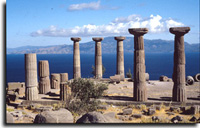
covering 3000 years of human occupation. During his stay in Troas, St.
Paul had a dream in which he saw a vision of a man asking him to "Come
over to Macedonia and help us" after which he decided to go to Europe.
All in all, he stopped and preached here 3 times. Assos perched high on
a cliff overlooking the Aegean and the Island of Lesbos is
breathtaking. Its Acropolis carries the impressive Temple of Athena.
Arriving at Assos on foot from Troas, St. Paul preached here and
climbed down to the little port on the shore to board the boat on his
return journey to Jerusalem. Dinner and overnight in Bursa.
Tour Day 15 -
Istanbul (Iznik/Nicea)
After the breakfast, we will visit the Yesil Cami (Green Mosque) and
the Yesil Turbe (Green Tomb). The Ulu Mosque is completely Seljuk in
style, a big rectangular building with immense portals and a forest of
supporting columns inside. After a stop at the Ottoman House Museum, we
leave Bursa behind us and drive to Nicea . The city was founded around
1000 B.C. In 325, the First Ecumenical Council was held here for the
purpose of condemning the heresy of Arianism. The Seventh Ecumenical
Council was also held here in the St. Sophia Church, which we will
visit first. The church was built in the 4th century and has a mosaic
floor which dates to the 6th century. All gates and walls date from the
Byzantine times. We proceed to Istanbul and check into our hotel.
Tour Day 16 -
Istanbul
Transfer
Please contact
for further information OR send us a request form

FOOTSTEPS
OF ST.PAUL TOUR
Guaranteed Departure
Dates |
Per person (in US Dollars) |
|
in
double room |
in
triple room |
in
single room |
April 9, May 14, June 11, July 16
August 20, Sept 17, Oct 8 |
1729 |
1683 |
2065 |
*
Istanbul / Adana domestic airfare is 100.USD extra
Hotels
to be used:
- Istanbul
- Senator or similar (4 star or small charm hotel)
- Izmir
- Anemon or similar (4 star hotel)
- Pamukkale - Lycus River or similar (4 star
hotel)
- Kusadasi
- Pine Marina or similar (4 star hotel)
- Adana - Surmeli or similar (4 star
hotel)
- Cappadocia - Surban or similar (special cave
hotel)
- Konya - Dundar or similar (4 star
hotel)
- Antalya - Antalya or similar (4 star
hotel)
- Ayvalik - Florium or similar (4 star
hotel)
- Bursa - Almira or similar (4 star
hotel)
|
Previous
Turkey Tour
- Other
Turkey Tours
- Next
Turkey Tour
|